AI agent
Restaurant chatbot that holds a table at peak hour
The Ecbot team ·
A restaurant chatbot is most useful at peak hour, when it answers the customer asking for a table on  WhatsApp or
  Messenger, holds one through a tool you connect, and hands large groups to the manager while staff are busy. Restaurant management software runs orders, the floor plan, stock and the till, but it usually does not answer chats, so the group books whichever place replies first.
Picture a Saturday at 6:52pm in a busy two-floor hotpot restaurant. The kitchen is sending out orders nonstop, there is a queue at the till, and the restaurant's  Facebook page gets this:
hi got table for 8 tonight? around 7.30. got private room or not
any vegetarian food? 2 of us vegetarian
Nobody on the floor has a free hand to pick up the phone. By 7:20, when someone finally can reply, the group has booked the place next door.
Six questions to ask before you choose restaurant management software
The first five help you pick software for the shift inside the restaurant. The sixth decides when that Saturday message gets an answer.
1. Can staff take orders and payments quickly?
Have your real staff try the demo during a busy shift. Good software is software a waiter in their second day can use to take an order, split a bill and print a receipt without asking anyone.
2. Does the floor plan match how you run the place?
A restaurant needs a plan by floor, joined tables and a mark for tables booked in advance. A cafe often only needs counter ordering and cup labels. A bar also needs VIP tables, minimum spends and notes for each event night.
3. Does stock come off by recipe?
When you sell an iced latte, stock should drop by the coffee, the milk and the cup on its own. Ask whether the software tracks recipes and warns you when an ingredient runs low.
4. Can reports be split by shift, staff and branch?
Once you run two or more outlets, you need each one's sales and losses without calling the manager to ask.
5. Can other systems read and write your data?
Ask the vendor whether there is an API, an export to  Google Sheets or a ready-made integration with other tools. If there is, other tools, an AI agent included, can check free tables and write bookings straight into your system.
6. Who answers customers before they walk in?
Customers ask "what time do you close", "got parking or not" and "table for 8 tonight?" on WhatsApp, Messenger and your website chat. Your restaurant management software does not answer these. If the honest answer is "whoever is free", the messages that arrive when you are busiest are also the ones that wait longest.
Why table requests wait right when you are busiest
People message about a table while they are deciding where to go, which means late afternoon, evenings and weekends. That is also when your staff are busiest, because the same customers are walking through the door. Restaurant management software and cafe management software keep the shift inside running smoothly, but your WhatsApp and Facebook inbox sits outside that shift.
The questions look alike from one type of place to the next:
- Restaurants: table for how many, private room, vegetarian options, a high chair for a baby, how to book a birthday dinner.
- Cafes: opening hours, sockets and wifi, a quiet corner to work, bookings for a group.
- Bars: live music tonight, the minimum spend for a VIP table, dress code, renting the whole venue for an event.
Most of these already have an answer in your menu, opening hours and house rules. Some need a check for a free table and a booking written down. A few, like a dinner for 40 or a deposit, need the owner to decide.
Restaurant management software and an AI agent do different jobs
The table compares the two job by job, as of October 2026.
| Job | Restaurant management software (POS) | AI agent (Ecbot) |
|---|---|---|
| Take orders, payments, print receipts | Yes | No |
| Stock by recipe, sales reports | Yes | No |
Answer WhatsApp, Messenger,  Zalo chats Zalo chats | Usually not | Yes, from your menu and house rules |
| Check free tables, record a booking | Yes, when staff enter it | Yes, through a tool you connect ( Google Calendar, your API) Google Calendar, your API) |
| Large groups, deposits, complaints | Staff handle them | Hands the chat to staff by guardrail and keyword |
| Remind customers before their booking | Depends on the software | Yes, a scheduled message in the same chat |
| Recognise a returning customer by chat | Depends, usually through loyalty | One customer profile across WhatsApp, Messenger, website |
Neither one replaces the other. The AI agent sits in front of your restaurant management software and your inbox: it answers the customer, then writes the result into the tools you already use. Many restaurant chatbots only answer from a script, while an AI agent answers and then holds the table. If you are not sure how an AI agent differs from a chatbot, AI agent vs chatbot: what is the difference? explains it.
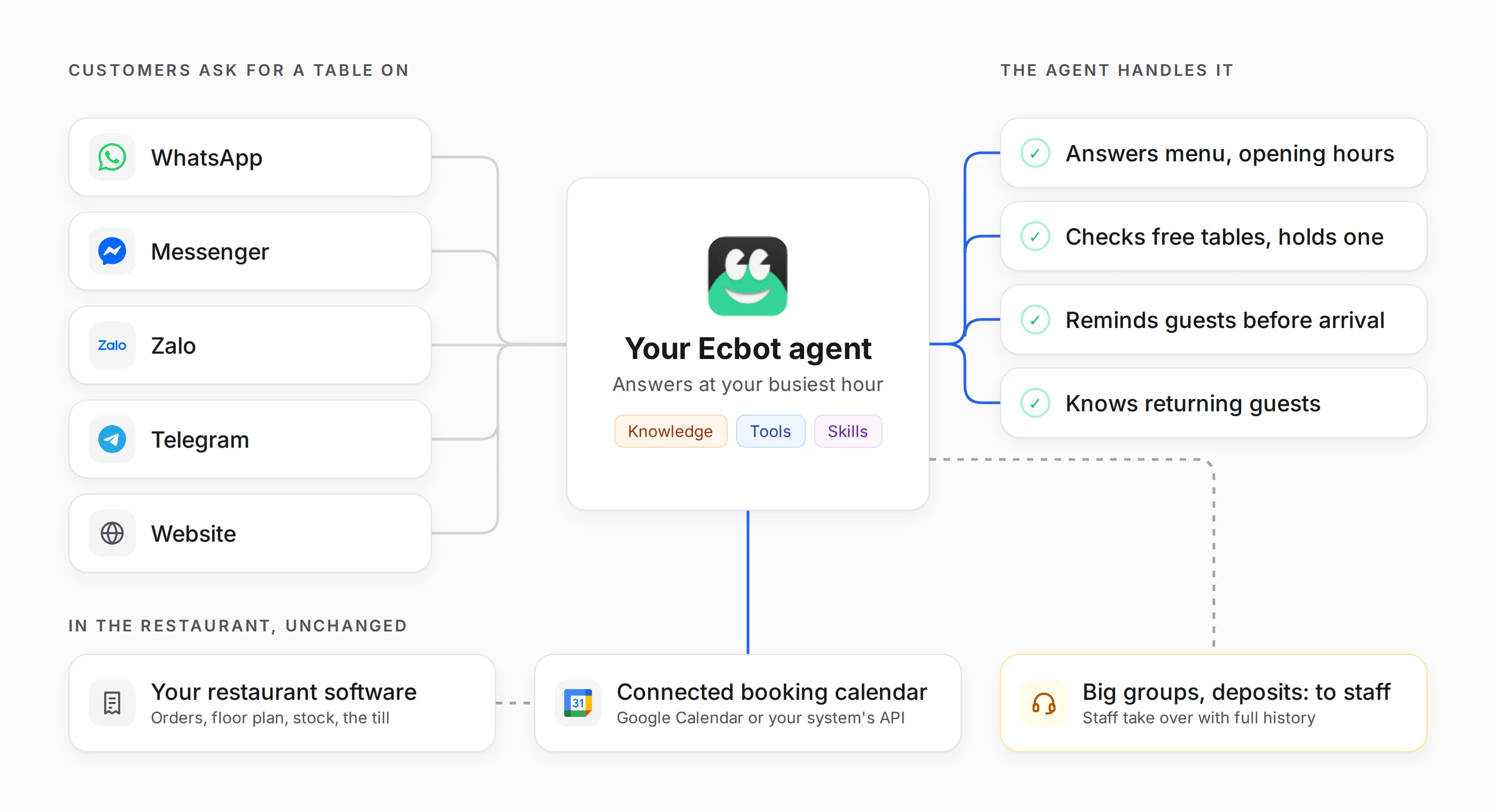
A restaurant chatbot that writes the booking into your tools
Ecbot is an AI agent platform for businesses that sell and serve customers over chat. You describe the job in one sentence, for example "answer table and menu questions for a two-floor hotpot restaurant, groups over 20 go to the manager", and Ecbot suggests a role, tone, goals and rules for the agent that you then edit. You upload your menu, opening hours and booking rules, and the agent answers from those documents only.
Back to Saturday at 6:52pm. With an agent connected to the restaurant's booking tool, the chat could go like this (names, times and group sizes are examples):
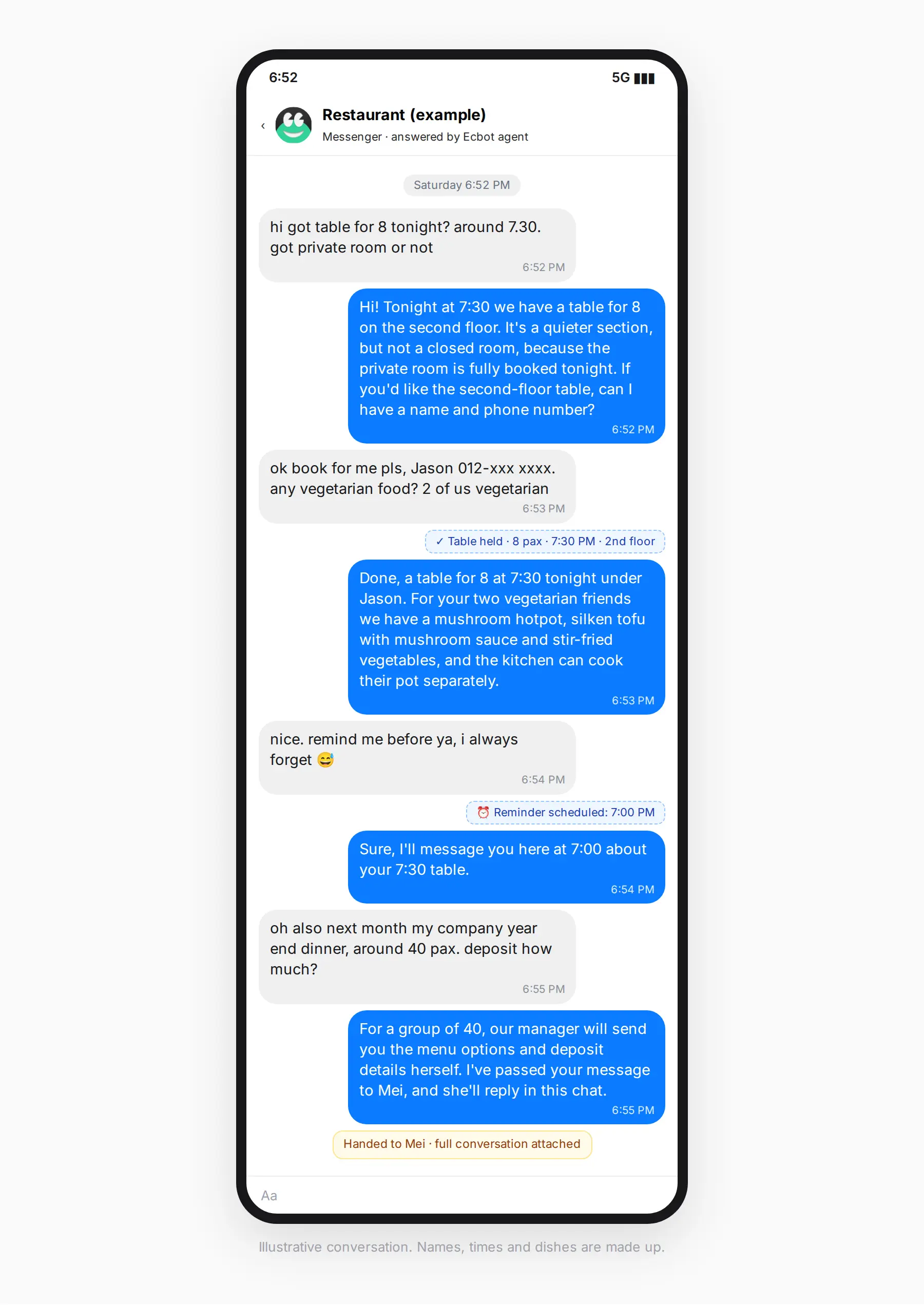
Behind that chat, the agent did the following:
- Checked and recorded the booking through your tool. The agent checks free tables and creates the booking through a tool you connect, for example Google Calendar through
 Composio, or your own system's API. Every tool call is logged, so the manager can see what the agent looked up, what it wrote and when.
 - Followed the playbooks you wrote. Ecbot has skills, step-by-step playbooks the agent opens only when a chat needs one, such as "group booking over 20 people", "customer asks about parking" or "customer reports a problem with a dish".
- Handed the chat to staff in the same inbox. You write a guardrail instruction, for example "groups over 20, deposits and complaints go to the manager", and set it to hand the chat over when it blocks a message. Keywords like "deposit", "event" and "refund" act as a backup. The chat also goes to staff when the customer asks for a person, or when the agent answers "I don't know" several times in a row. Staff get the chat with a handover note, read every message from every app in one inbox and take over. The guardrail uses an AI classifier, so it can miss a message now and then. Test it with a few of your old customer messages before you switch it on.
- Kept one profile per customer across apps. If Jason messages on Messenger today and on WhatsApp next week, he still has one customer profile. When two profiles share a phone number, Ecbot suggests merging them, staff confirm, and from then on the agent sees he once booked a table for 8.
- Scheduled a reminder before the booking. The agent schedules a message to the same customer on the same channel, from 1 minute to 30 days ahead, with at most 5 pending per conversation. The customer can ask for one ("remind me before ya"), or you set rules such as "remind customers the afternoon before their booking" or "remind groups about the deposit 2 days before the event". When it fires, the agent rereads the chat and writes a fresh message, and skips it if the conversation was resolved or the agent was turned off. The follow-ups docs show how to set it up.
- Kept every message. Incoming messages are queued and retried if the system hits a problem, so nothing disappears in the middle of the dinner rush.
One agent runs on WhatsApp, Messenger, Zalo (for restaurants in Vietnam),  Telegram and your website chat at the same time. Ecbot is also open source: if you run it on your own server, your menu, rules and customer data stay in your own database.
Reminders live in the chat and are not synced with your booking calendar or restaurant management software. If staff move a booking in the software, the scheduled reminder keeps the old time, so when you change a booking, have staff message the customer in the same chat. Ecbot does not connect to food delivery apps, and the agent can only book a table once you connect a tool that records bookings, such as Google Calendar or your software's API.
When your restaurant does not need an AI agent yet
A small cafe or eatery that serves mostly walk-ins, does not take bookings and gets a few messages a day about opening hours does not need an AI agent. A greeting message on your Facebook page, plus answering a few chats yourself each day, is enough.
An agent is worth trying when at least one of these is true: table requests pile up in the evening and at weekends, you take group or event bookings over chat, or you answer customers on two or more chat apps.
Start with your menu and booking rules
If you already use restaurant management software, keep it. Put your menu, opening hours and booking rules in one file, create a booking calendar in Google Calendar if your software has no API, and let the agent answer the chats your staff cannot reach at peak hour. To see how an agent works before you try one, read What is an AI agent?.
When you are ready, try Ecbot and set up your first agent from one sentence about your restaurant.
Frequently asked questions
What should restaurant management software include?
At minimum: ordering and payments, a floor plan, stock tracked by recipe, and sales reports by shift and by branch. If you take bookings over chat, also ask whether it has an API or exports to Google Sheets, so the tool that answers your messages can write bookings into it.
How is cafe management software different from restaurant management software?
A cafe needs fast counter ordering, cup labels and a loyalty program, and rarely a complex floor plan. Restaurants and bars need a floor plan, advance bookings, private rooms and group events. Many vendors sell a separate plan for each.
Can restaurant management software answer booking messages on WhatsApp or Messenger?
Usually not. It runs the work inside the restaurant, so messages on WhatsApp, Messenger or your website chat still wait for whoever on staff is free. An AI agent like Ecbot answers them from your menu and booking rules, then records the booking in a tool you connect.
Should a restaurant chatbot take deposits for large groups?
No. In Ecbot you write a guardrail instruction such as "large groups, deposits and complaints go to a person" and add backup keywords like "deposit" and "40 pax". When a message matches, the chat goes to your staff in the same inbox. The agent can still send a deposit reminder the afternoon before.
Does a small cafe need an AI agent?
Not always. If you mostly serve walk-ins and get a few messages a day about opening hours, answering them yourself is enough. An agent pays off when table requests pile up at dinner time and nobody has a free hand to reply.